


Scarpa F1 RS Ski Touring Boots
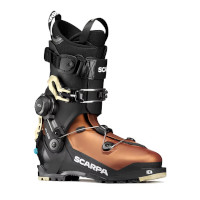
Scarpa’s lightweight touring F1 line gains a new family member for Fall 2026: the F1 RS. This is the stiffest boot in the lineup, with an impressive 115 flex rating, with a weight of just 2,680g per pair. While it’s not as light as the F1 LT (Scarpa’s lightest F1) at 1,980g per pair, the RS is still lighter than the F1 XT and only slightly heavier than the F1 GT. The RS is also noticeably stiffer than both the XT LT and GT thanks to its new Overlap Flow Construction. With added stiffness comes extra weight and a smaller range of motion, but is the trade-off worth it? Read on for my take.
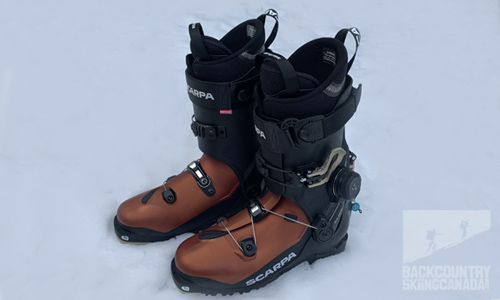
- SHOW THE REST OF THE REVIEW / PHOTOS / VIDEOS
-
To put the F1 RS in context, here’s a quick snapshot of Scarpa’s F1 lineup (weight is per pair):
Scarpa F1 RS Alpine Touring Boots
Weight: 2,680g
Flex rating: 115
Cuff rotation: 60°
Scarpa F1 LT Alpine Touring Boots
Weight: 1,980g
Cuff rotation: 72°
Flex rating: 100
Scarpa F1 XT Alpine Touring Boots
Weight: 2,290g
Flex rating: 95
Cuff rotation: 72°
Scarpa F1 GT Boots
Weight: 2,310g
Cuff rotation: 72°
Flex rating: 90Coming from the F1 LT, several key differences stand out on the new F1 RS:- The F1 RS has 12° less range of motion than the F1 LT due to the Overlap Flow Construction replacing the LT’s fabric tongue.
- This Overlap Flow Construction bumps the flex to 115 versus the LT’s 100.
- The F1 RS is 350g heavier per boot than the LT, and it’s priced about $50 US more.
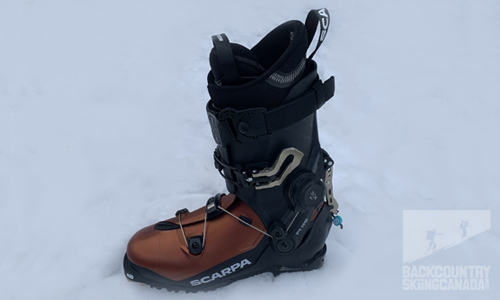
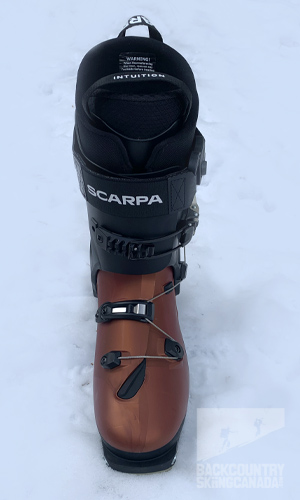
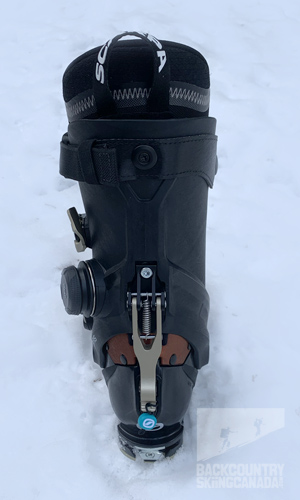
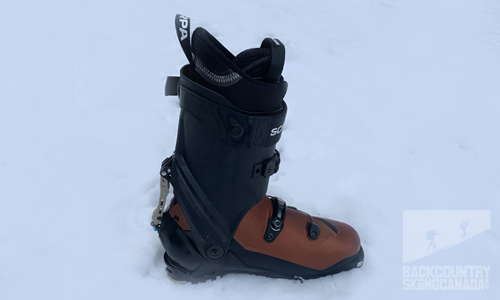
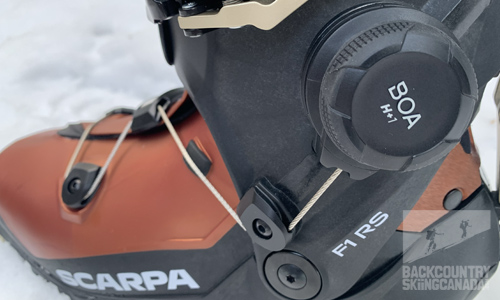
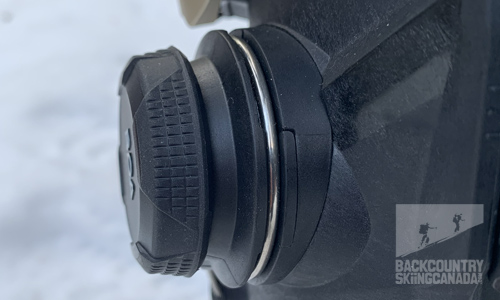
Two main innovations define the F1 RS. The first is the H+1 BOA System, which uses a dial located on the upper cuff to remotely control the BOA closure on the lower shell. This unique dial placement makes it easier to micro‑adjust the lower fit on the fly—tighter or looser as needed—and it’s a Scarpa first. You can tune a precise fit for your forefoot with even pressure distribution, giving a smoother, more consistent tension that improves fit and downhill performance with minimal weight penalty, and the BOA system is guaranteed for life.
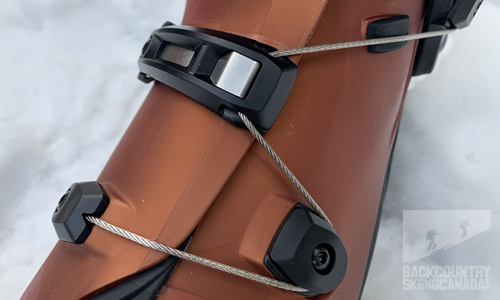
The second big update is Scarpa’s Overlap Flow Construction, which uses stiff Grilamid Fibreglass LFT co‑moulded in key areas with softer Pebax to create an upper cuff that’s rigid enough to achieve a 115 flex rating. The result is a relatively stiff boot overall that still flexes over the instep and at the front of the cuff for a progressive forward flex. This maximizes power transmission through the lower shell to the ski, boosting performance and control on the descent. The softer instep helps keep entry and exit into the boot manageable and preserves a natural range of motion while skinning.
Grilamid Fibreglass LFT is a Grilamid plastic reinforced with long strands of fibreglass, producing a material with a very high strength‑to‑weight ratio and excellent stiffness. Pebax Renew is a bio‑based thermoplastic elastomer made from castor oil that stays flexible in cold temperatures, has high cold‑impact resistance, and provides impressive energy return. Together, these materials deliver the rigidity and forgiveness you want in a stiff yet relatively lightweight ski touring boot.
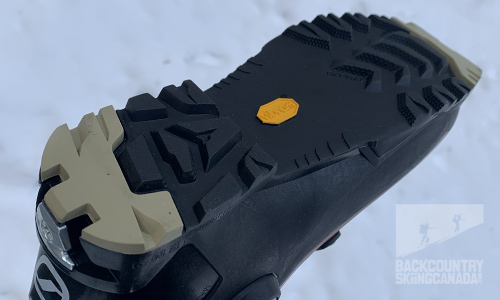
Underfoot, a Vibram outsole with an aggressive lug pattern and Top 85 rubber compound provides durable, cold‑specific grip so you get solid traction on a wide variety of surfaces.
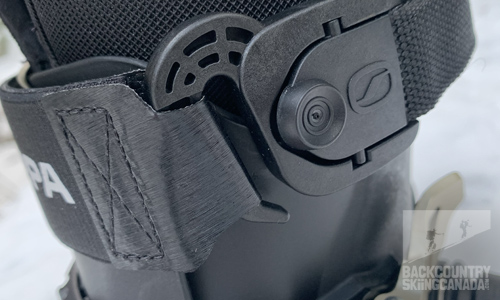
RECCO technology is integrated into the Velcro power strap—a Scarpa first—allowing rescue teams equipped with RECCO detectors to quickly pinpoint a victim’s precise location in the event of an emergency.
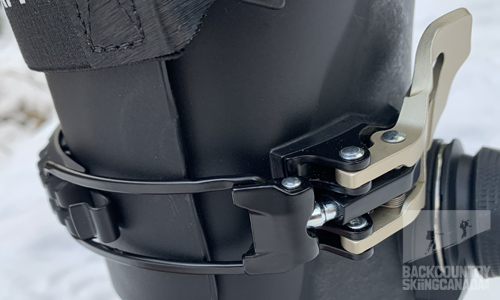
The new plastic hook on the Booster Power Strap, complete with a glove‑friendly release button, offers easy adjustability with a bit of elastic stretch so you can really crank it down for added performance.
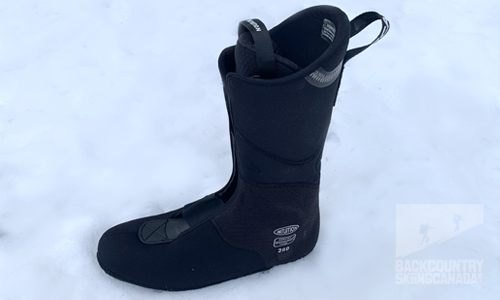
Like all Scarpa ski boots, the F1 RS uses thermo‑formable liners with multi‑density, closed‑cell foam layups that can be customized for a precise fit to maximize comfort and warmth.
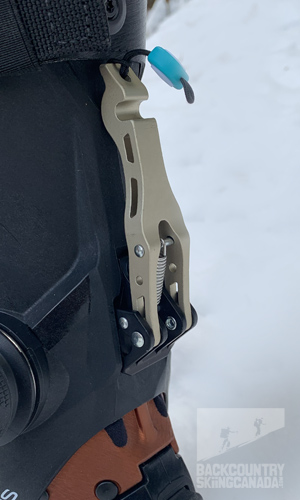
 The ski/walk mechanism remains fairly unchanged from other iterations—"if it ain't broke don't fix it".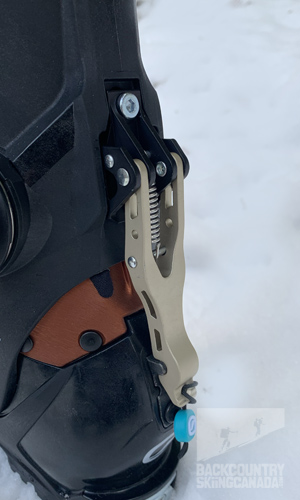
Materials:
Shell/Cuff/Tongue: Grilamid® Fibreglass LFT, Pebax Rnew®
Features:
- Overlap Flow Construction: Makes the boot easier to put on and take off while still delivering an efficient range of motion for touring and walking.
- Liner: Intuition FS Tour liner for instant comfort and a fully thermoformable, custom fit.
- Ski/Walk Mechanism: Lightweight system with automatic return and Friction Free technology for quick transitions and a smooth, natural stride.
- Closure: 1 buckle + BOA® Fit System + Booster® Power Strap.
- BOA® H+1 System: Geared design for strong shell closure and multidirectional micro‑adjustments, allowing effortless, precise fit control.
- Outsole: Vibram® FS with Durastep rubber and Traction Lug design for excellent grip, durability, and traction in all conditions.
- Binding System: TLT, AT compatible.
Verdict:
A lightweight touring boot like the F1 has always been a blessing on the skin track, but traditionally that weight savings comes at the cost of skiability. The F1 LT was my go‑to touring boot for years, but after moving from the Blizzard Zero G 105 to the Dynafit Free 107, the LT could no longer deliver the performance I needed—it was a classic case of “too much ski for too little boot.” https://www.backcountryskiingcanada.com/Blizzard-Zero-G-105-Skis
https://www.backcountryskiingcanada.com/Dynafit-Free-107-Skis
Because of this the new F1 RS, with its 115 flex, is exactly the upgrade I was looking for. A 15‑point jump in stiffness is substantial for a boot in this weight class and mean that the F1 RS confidently drives a more demanding, less skimo‑oriented ski. There is a trade‑off for this increased stiffness, however, the F1 RS is 700g heavier per pair than the LT, and you lose 12° of cuff rotation in walk mode. In practice, though, I’ve found that the weight penalty is more than acceptable and the reduced range of motion barely noticeable.
With the F1 RS, I can run a single touring boot across several different skis. It pairs nicely with a lighter, faster setup and also with a more freeride‑oriented ski for harder charging and more technical terrain. With its higher flex rating, the F1 RS sits closer to Scarpa’s Maestrale RS in terms of feel—the F1 RS is, however, a touch lighter and slightly softer. The Maestrale RS has also been updated for the 2026/27 season, and you can read that review here. Another boot in this same weight/flex category is the La Sportiva Kilo, which is worth a look if you are shopping for alternatives.
Beyond the added stiffness and improved power strap, the biggest surprise with the F1 RS was how well it fit straight out of the box. Credit here goes to the combination of the BOA H+1 system and the Overlap Flow Construction. The old F1 LT used a much lighter, more delicate BOA that I could easily max out while still wanting more pressure over my forefoot. The BOA H+1 on the new F1 RS is the same system found on the Atomic Hawx Ultra/XTD, Fischer RC4 MV/Pro, K2 Recon/Anthem/Mindbender, and Salomon S/PRO Supra boots. If it’s good enough for those big‑mountain chargers, you know that it will be more than enough for the F1 RS touring boots.
The only downside I could find with the new F1 RS Boots is that they are difficult to put on and take off. Because the F1 RS uses a more rigid overlap shell design than its predecessors, it’s significantly harder to get into—think full‑on alpine race boot. It’s not a deal‑breaker, but my first few attempts were surprisingly challenging. I quickly discovered that by spreading the lower shell as wide as possible while sliding your foot in helps a lot, and once you’re in and buckled, the secure fit and micro‑adjustability of the BOA H+1 system quickly makes you forget about the extra effort required.
If you’re looking for a very capable touring boot that won’t back down from driving a wide, demanding ski in challenging terrain—and you’re still somewhat weight-obsessed when it comes to overall gear weight—the new F1 RS should be high on your list of potential options. Thanks to Scarpa’s trademark fit and performance, combined with excellent foothold, the F1 RS is my new go‑to touring boot. This is the F1 I have been waiting for Scarpa to create. Thank you, Scarpa!
 |
PROS:
|
 |
CONS:
|
SPECS:
Price: $949 CAN / $849 US
Forward lean: 15° +/- 2°
Flex: 115
Range of motion: 60°
Weight: 1,340g / 2 lb 15.3 oz (½ pair, size 27)
Sizes: 24.5–31 (half sizes)
Last: 101mm
RATING: 9/10
Cuff Rotation: 2/2
Function: 1.5/2
Weight: 1.5/2
Quality/Price: 2/2

Leave a Comment:

Did we miss something? Are we totally out to lunch? Let us know what you think. People like/dislike gear for different reasons so chime in below and we'll get a well-rounded evaluation. You'll need to login or register before you can comment but it only takes a few seconds, then you're good to go.