


• Weekly avalanche conditions report
    Weekly Episode

    Avalanche Conditions Report

    Weekly snowpack summary covering Rogers Pass, the Selkirks and the Canadian Rockies. Published every Friday throughout the season.

    Listen Now →

    Weekly avalanche & safety updates throughout the season

  • BSC Guide Books
    Proprietary Content

    BSC Guide Books & Maps

    Researched and written by our team. Printed guides and georeferenced digital maps for Canada's best backcountry terrain.

    Shop the Store →

    Printed guides + georeferenced digital maps — all authored by BSC

  • BSC Membership

    Access 300+
    Full Routes

    Subscribe to Backcountry Skiing Canada and unlock complete route descriptions, trailhead details, approach beta, seasonal conditions and linked digital maps — for every route we've documented across Western Canada.

    • 300+ full route descriptions with trailheads, approach notes and descent options
    • Georeferenced digital maps — Gaia GPS and CalTopo compatible
    • ATES-rated and updated each season with current conditions beta
    • Support independent backcountry skiing content since 2009
    Subscribe to BSC Browse free content →

    Route details also available in BSC printed guidebooks

  • Know Before You Go

    Check Today's Forecast

    Real-time avalanche danger ratings updated daily by Avalanche Canada. Always check before heading out.

    View Forecast →

    Avalanche awareness saves lives

  • Know Before You Go

    Check Today's Forecast

    Real-time avalanche danger ratings updated daily by Avalanche Canada. Always check before heading out.

    View Forecast →

    240+ videos — gear reviews, conditions reports & backcountry edits

Brooks-Range Ultralite Rescue Sled - REVIEW

  • Online
    2011-03-05 22:26:53

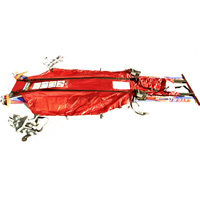
    Brooks-Range Ultralite Rescue SledBrooks-Range is a company fast becoming know for designing and producing innovative backcountry rescue gear, from bivies and avi gear to the three rescue sleds they currently offer.

    The lightest and most suited to backcountry skiers is the Brooks-Range Ultralite Rescue Sled which weighs in at 705.9 grams or slightly more than a thermos of hot tea.

    The Ultralite Rescue Sled is comprised of five 24" backcountry ski straps and two Pro Stretcher Bars that are made up of four nested aircraft quality aluminum locking bars which are all contained within the ultralite rip-stop nylon sled, 'taco roll' style. The entire package is quite compact and packs down to the size of a small down jacket (4 x 11 x 2"). It gives you everything you need (except for the tow rope) to build a solid sled out of the subjects skis and poles and securely fasten them for transportation.


    Have a look at the full review in our gear review section here, and let us know what you think – is the Brooks-Range Ultralite Rescue sled something you would consider?



  • 2011-03-08 21:42:30

    Great write up!  It's actually kind of fun to play with isn't it?  I've been carrying one of these for years, and I have a hard time going out without it now.  

    One addition that I have made to my sled is a 10-meter length of 6mm cordelette.  I don't mind carrying 10-meters of thin cord, since I feel it can serve lots of functions.  In practicing with the sled, I like the piece of mind that comes when I increase the strength of the sled while pulling pulled on from one end.  

    I put an eight-on-a-bite at the mid-way point of the cord.  Then I clove-hitch the cord to the "front" stretcher bars so I have a triangle to pull on.  Then the cord goes back to the opposite binding (opposite from the tip it started at) and then back to the tail at the same side it originated.  Before I fasten it to the tail, I put an overhand-on-a-bite in the cord, then it goes around the back stretcher bar, through the overhand loop, and pulled to create a lot of tension.  This can actually flex the ski, which I think is a good thing.  I fasten this with another clove-hitch on the rear stretcher bars.  I run the remaining cord back and create a loop.  

    This makes it so I have a solid attachment point for a rope at both ends of the sled.  It also makes it so that as I pull in one direction, some of the load is actually absorbed by the bars at the opposite end.  It gets pulled together, rather than apart.  

    With this set up I have never had one pull apart, even while lowering down 40-degree slopes.

    I hope this is helpful. 


  • Online
    2011-03-08 22:09:55

    Super helpful and something I would not have thought of. I followed that description but I am sure many readers would be scratching their head - perhaps the next time you are using the sled you could take a quick picture for everyone to see exactly what you mean?


    It would be a good visual for all and I have heard a picture is worth a thousand words.


    Thanks for the feedback and advice.